The Effect. Caxton Theatre, Grimsby. 15 October 2026.


Lucy Prebble’s challenging psychological drama is given a gripping, cinematic treatment under the direction of Stephen Labourne.

There are theatrical productions that entertain us for an evening, and there are those that send us away with questions we are still turning over in our minds long after the curtain has fallen. Lucy Prebble’s The Effect, currently playing at Grimsby’s Caxton Theatre, firmly belongs in the latter category. A provocative exploration of love, attraction, mental health and the influence of medication on human behaviour, this is a production that challenges its audience to consider just how much control we really have over our feelings, and whether what we experience as love can ever be separated entirely from the chemistry of the brain.

Under the direction of Stephen Labourne, Prebble’s play becomes a tightly controlled, often claustrophobic piece of theatre that never loses its grip. Labourne has once again demonstrated his willingness to seek out unusual and less frequently performed plays, bringing something distinctive to the Caxton stage. His direction is cinematic and slick, with a pace that never drops and an atmosphere that steadily intensifies as the experiment at the heart of the story unfolds.

The play follows Connie and Tristan, two participants in a clinical drug trial whose growing attraction to one another becomes increasingly difficult to disentangle from the effects of the medication they are taking. As their relationship develops, the doctors overseeing the experiment, Lorna and Toby, are faced with questions that reach beyond the immediate parameters of their research. How can they distinguish a genuine emotional connection from a chemical response? And what happens when the boundaries between professional responsibility, personal experience and scientific certainty begin to blur? Prebble skilfully builds these questions into a drama that is as much about the people conducting the experiment as those undergoing it. Without revealing the play’s twists and turns, suffice to say that the answers are neither straightforward nor comfortable.

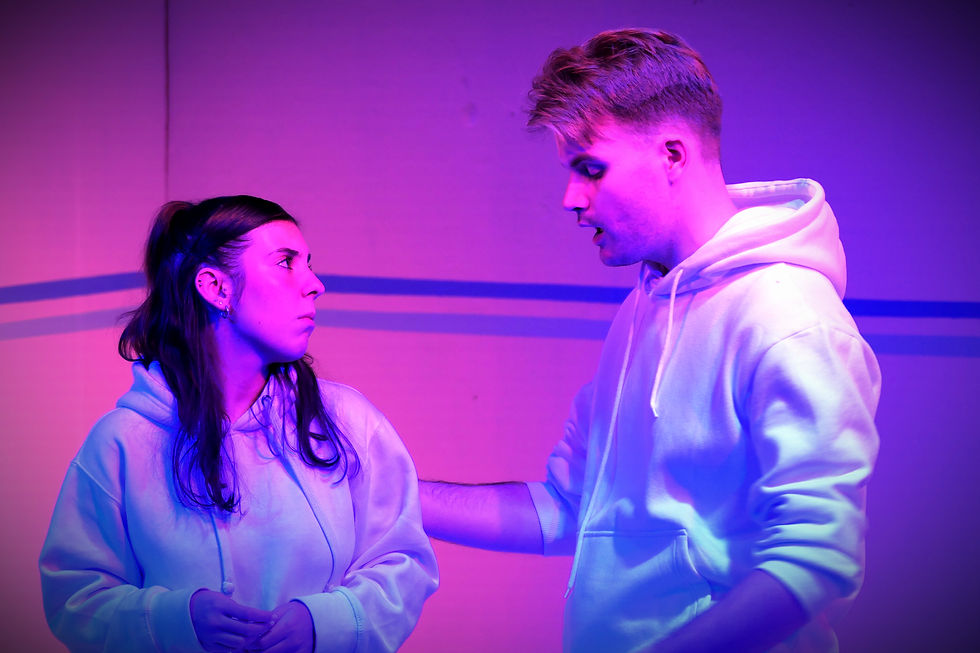
The production’s visual language is particularly effective. The set is stark, clinical and functional, with two hospital-style screen doors providing the principal entrances and exits. There is nowhere for the characters, or the audience, to escape the scrutiny of the experiment. Deliberately harsh lighting reinforces the sense of exposure, while a restrained palette, with a subtle hint of blue, lends the stage a cool, institutional atmosphere. The participants’ white leisurewear further emphasises their vulnerability within this controlled environment. Personal props are kept to a minimum: medication cups, mobile phones and a tablet used by the psychiatrist observing and conducting the experiment are virtually the only objects to disturb the austerity of the stage.

Against this carefully maintained minimalism, one moment of particular visual interest comes when Toby produces a model of a brain during one of his monologues. It is an effective contrast to the otherwise stripped-back staging, a tangible representation of the very thing the characters are attempting to understand. The brain may be an object that can be held and examined, but the emotions it generates are considerably harder to measure.

Jade Priestley as Connie gives an energetic and exuberant performance as one half of the increasingly complicated relationship at the centre of the play. Priestley makes Connie’s emotional journey both credible and compelling, allowing us to invest in her growing attraction to Tristan while never losing sight of the uncertainty surrounding their circumstances. There is a palpable chemistry between Priestley and Ed Wells, and their developing relationship provides the production with much of its emotional momentum. Audiences familiar with Priestley’s work with the late, lamented Class Act Theatre may be pleased to see her here, although she is no stranger to the Caxton, having previously appeared in Decision Height and Five Kinds of Silence. This is another strong contribution to her growing body of work on the stage.

Ed Wells makes a particularly memorable Caxton Theatre debut as Tristan. He brings an infectious energy and exuberance to the role, creating a character whose attraction to Connie feels immediate and convincing without making the relationship seem too easy or predictable. His performance captures the excitement of a new connection while allowing the doubts and uncertainties surrounding the experiment to remain present. The chemistry between Wells and Priestley is one of the production’s great strengths; their scenes together possess a natural vitality that makes us want to believe in the relationship, even as the play encourages us to question its origins. Wells is a welcome new presence at the Caxton, and this is an impressive debut that leaves one hoping to see considerably more of him in future productions.

Amy Wilson as Lorna delivers another highly credible and carefully differentiated character. Reuniting with Labourne, having appeared in three of his previous productions, Wilson demonstrates once again her ability to find new territory in a role. Lorna’s professional position places her at the centre of the experiment’s scientific and ethical questions, but there is also a personal dimension to her involvement that adds considerable tension. Wilson negotiates these layers with assurance, bringing frustration and emotional complexity to a character who must maintain authority while confronting uncertainties that cannot simply be resolved by professional expertise. Her performance is a reminder of how effectively she can transform herself from one production to another, never allowing familiarity with an actor to diminish the individuality of the character being portrayed.

Si Duffy as Toby completes the quartet with a performance that combines menace, frustration and a welcome thread of dark humour. Making their Caxton Theatre debut, Duffy establishes Toby as a character whose presence complicates the experiment in ways that extend beyond the clinical setting. There is a wonderfully palpable tension between Toby and Lorna, rooted in their prior relationship, and Duffy ensures that the history between them feels significant even when it remains only partially understood. Their exchanges carry an undercurrent of unresolved feeling that invites the audience to speculate about what has gone before. Duffy handles the darker aspects of the role with confidence, while the flashes of humour prevent Toby from becoming a one-dimensional figure of authority. It is a performance that adds another intriguing layer to an already densely constructed drama.

The strength of this production lies in the way all four performances work together. The two participants bring an exuberant physical and emotional energy to the stage, while those conducting the experiment introduce a different kind of tension: more restrained, perhaps, but no less potent. The result is a constant interplay between the personal and the professional, between what the characters believe they know and what their experiences are forcing them to question.

Labourne deserves considerable credit for maintaining this balance. The direction is precise without feeling mechanical, and the slick transitions, confined setting and uncompromising lighting all contribute to a growing sense of claustrophobia. We begin to feel something of the participants’ predicament ourselves, caught within an environment where every reaction might be scrutinised and every emotion potentially explained away. The pace is relentless without becoming breathless, allowing the ideas to register while ensuring that the dramatic tension never dissipates.

Ultimately, The Effect is a challenging and thought-provoking piece of theatre that refuses to offer easy answers. It asks uncomfortable questions about the nature of love, the limits of science and the stories we tell ourselves to make sense of our feelings. Prebble’s writing gives the cast plenty to explore, and this production meets those demands with intelligence, commitment and considerable theatrical flair.

One leaves the theatre with much to discuss, much to question and, perhaps most importantly, a renewed appreciation of what live theatre can achieve when it refuses to play safe.
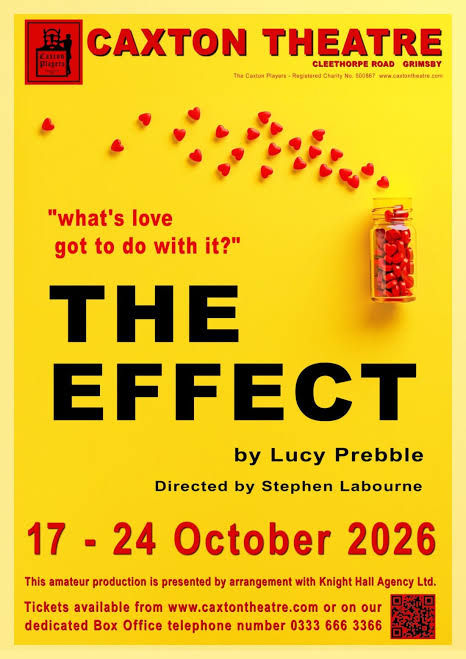
The Effect runs at the Caxton Theatre, Grimsby, from Saturday 17 to Saturday 24 October. Tickets remain available through the usual outlets. If you enjoy theatre that challenges as much as it entertains, this is a production well worth seeking out. And, having once again demonstrated his eye for an intriguing theatrical venture, we can look forward with interest to Stephen Labourne’s next project as director.
Andy Evans 15 October 2026


Comments