Blood Brothers. Grimsby Auditorium. 6 - 10 October 2026.


Images supplied by Bill Kenwright Limited and all subject to copyright. Images may feature former cast members rather than current cast members.
There are some musicals that depend upon spectacle, some that rely upon a hit score and
others that survive because audiences simply love the familiarity of returning to a story they know. Willy Russell’s Blood Brothers manages something considerably more difficult: it makes an audience laugh at the very same time as it quietly prepares to break its heart.
The latest touring production from the Bill Kenwright Limited arrives at Grimsby Auditorium with a formidable reputation behind it – and, importantly, proves that Blood Brothers remains every bit as powerful as ever.

Russell’s story, set against the social divisions of Liverpool, begins with a deceptively simple premise. Mrs Johnstone, already struggling to support her family, gives one of her newborn twins to her wealthier employer, Mrs Lyons. Mickey and Eddie therefore grow up as brothers who are separated not by geography, but by class, circumstance and opportunity. Their eventual friendship is warm, funny and entirely believable, which makes the tragedy waiting at the end all the more devastating.

At the centre of this production is Vivienne Carlyle as Mrs Johnstone, and she gives the role precisely the mixture of toughness, vulnerability and earthy humour it demands. Mrs Johnstone can easily become a caricature of the impoverished working-class mother, but Carlyle finds the woman beneath the circumstances. Her gradual transformation from optimistic young mother to a woman worn down by events gives the production much of its emotional weight. The great test, of course, comes with Tell Me It’s Not True, and Carlyle delivers the show's final moments with considerable emotional force. By this stage, the audience has travelled a long way with Mrs Johnstone, and the song becomes less a conventional musical-theatre finale than an expression of accumulated grief.
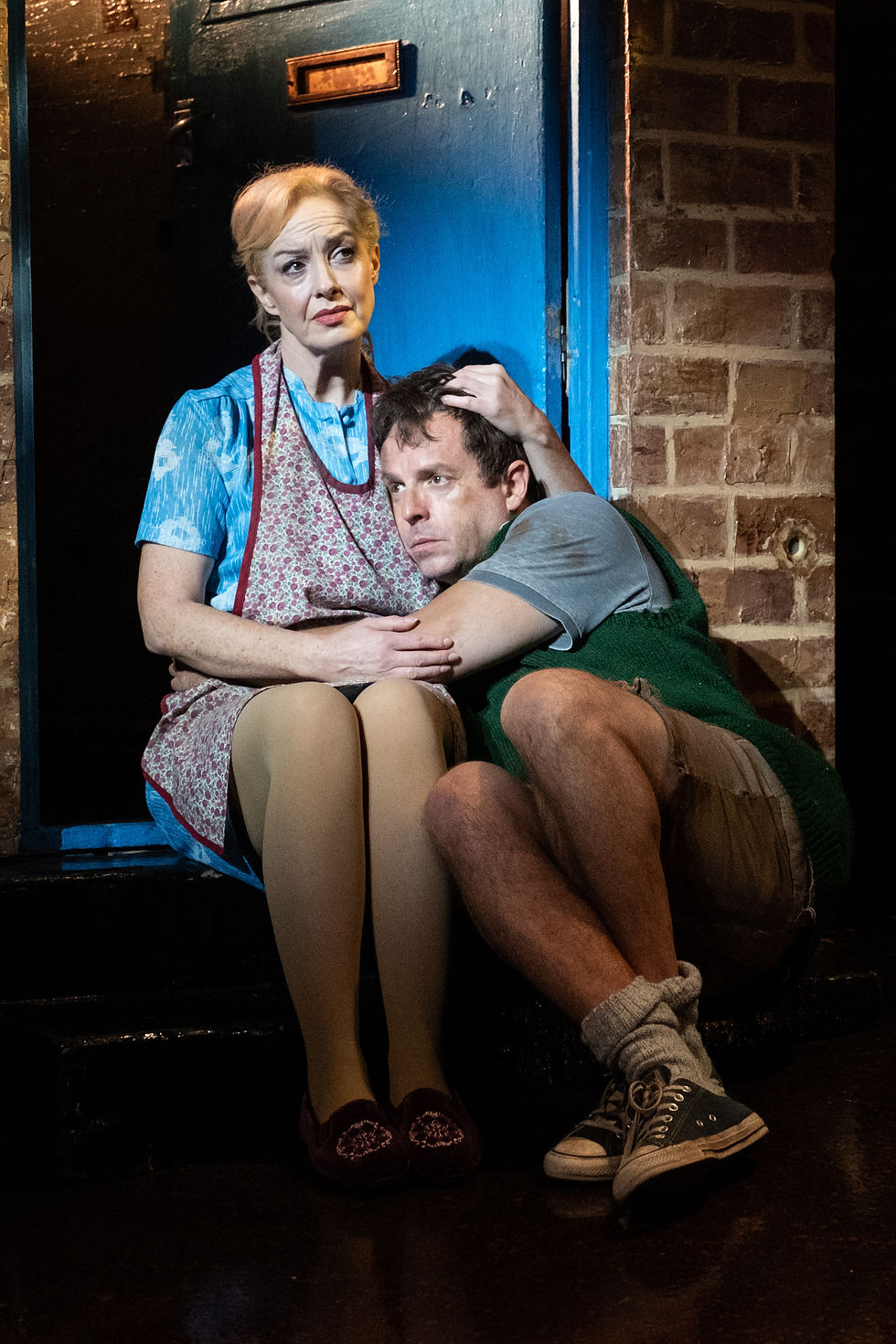
Opposite her, Tricia Adele Turner’s Mrs Lyons provides an effective contrast. Her portrayal of the wealthy Mrs Lyons was quite awe-inspiring as she slipped from pain to greed, to bile as the story progressed. Where Mrs Johnstone's desperation is born from poverty, Mrs Lyons' increasingly destructive behaviour grows from privilege, fear and an obsessive desire to possess the child she has been unable to have herself. Turner handles the character's descent magnificently, allowing the audience to see how insecurity develops into something considerably darker.

As the twins, Sean Jones and Joe Sleight make a particularly strong partnership. Jones' Mickey is immediately engaging, with an appealing mixture of cheekiness, vulnerability and energy, while Sleight's Eddie possesses the confidence of someone who has grown up believing that the world is naturally there for him. Their chemistry is crucial because the relationship between the two boys must feel completely natural. Here, it does. The on-stage relationship between the two is clearly the product of a lot of time spent touring the show together. Jones is immediately dynamic, witty and interesting and Sleight makes excellent use of physical comedy to act brilliantly as the unwitting straight man to Jones. Their desperation at being parted feels natural and the chasm that privilege opens up is clear as the action progresses in Act Two. It is also interesting to note that whilst Sleight has played Eddie since 2023, Jones as been playing Mickey for over 25 years having first been an understudy from 1999 and later the principal from 2001. That is a seriously impressive commitment.

Beth Danher's Linda is equally important to the emotional balance of the story. She avoids making Linda merely the girl caught between two brothers, instead giving her a clear sense of her own identity and a believable affection for Mickey. Her relationship with him becomes increasingly poignant as the inequalities surrounding them become impossible to ignore. Danher's comedic timing is impeccable and the maturing of Linda as the world grinds her down in adulthood felt very real.
Michael Gillette makes an impression as Sammy, giving the character the necessary menace without allowing him to become a cartoon villain, while Tim Churchill brings an appropriate combination of authority and unease to Mr Lyons. Sarah Moss, Amelia Poggenpoel, Jamil Abbasi, Jack Anthony Smart, Graeme Kinniburgh and Alex Harland efficiently populate the world around the central characters, handling the production's multiple supporting roles with energy and clarity.

Hovering over all of them is Kristofer Harding's Narrator. The role is one of the most distinctive devices in Blood Brothers: part Greek chorus, part storyteller and part ominous warning of what is to come. Harding gives the Narrator the necessary presence without allowing him to overwhelm the story. His repeated reminders that the ending is already written create a fascinating tension – we know exactly where the characters are heading, but Russell makes us hope, nevertheless, that somehow they will escape their fate.
And that is one of the great achievements of Blood Brothers. It may be a story about separated twins, but Russell is really examining whether people are shaped by nature or nurture, and whether social class determines how much opportunity a person is given. The production never needs to lecture its audience about these ideas. They emerge naturally from the lives of Mickey and Eddie.

The score remains one of the show's great strengths. Songs such as Bright New Day, Marilyn Monroe and Tell Me It’s Not True are woven into the storytelling rather than appearing simply as opportunities to stop the action and sing a number. The music helps chart the changing lives of the characters, moving from humour and optimism towards something much darker. There is also a particular pleasure in watching Blood Brothers in a touring production. Its world is not dependent upon enormous spectacle. Instead, the emphasis is placed where it belongs – on the writing, the performances and the relationships between the characters. That makes the production feel immediate and human.
And despite knowing exactly what is coming, the final moments still land.
That is perhaps the greatest compliment that can be paid to a production of Blood Brothers. The story is familiar. The songs are familiar. The destination is familiar. Yet when the final tragedy arrives, there is still a palpable sense of shock and sadness around the auditorium. The first night was greeted with a well-deserved standing ovation as the cast took several bows. The ultimate Grimsby compliment came in the Gents at the end of the show as two burly Grimbarians looked at each and said "That was quite good that" in a very understated manner but thoroughly meaning it.

Nearly forty years after its musical transformation, Willy Russell's Blood Brothers has lost none of its ability to entertain, provoke and ultimately devastate. This latest Bill Kenwright touring production understands that the secret is not to overcomplicate the material, but to trust Russell's writing and allow a strong company to tell the story.The result is an emotionally charged evening of musical theatre that can make you laugh one moment and leave you reaching for the tissues the next. A powerful, funny and ultimately heartbreaking revival of one of British musical theatre's enduring classics.

Andy Evans 6 October 2026


Comments